Who operates stations in the Antarctic?
- Polar
- May 4, 2026
Shiela Sandoval
Antarctica shall be used for peaceful purposes only. There shall be prohibited, inter alia, any measures of a military nature, such as the establishment of military bases and fortifications, the carrying out of military maneuvers, as well as the testing of any type of weapons.
— Article 1 of the Antarctic Treaty
In 1959, the Antarctic Treaty was signed by 12 countries designating all land and ice shelves south of 60° South latitude as a place for scientific research and where any sort of military activity or weapons testing is prohibited under international law. The original signatories were Argentina, Australia, Belgium, Chile, France, Japan, New Zealand, Norway, South Africa, the USSR, the United Kingdom, and the US. Many more countries have joined the treaty since its ratification in 1961. There are now 58 countries to accede to the treaty, the latest of which, as of writing, was the United Arab Emirates in 2024[1].
Acceding to the treaty allows a nation to participate in research activities in the continent either by establishing a scientific station there or by sending representatives on a scientific expedition. There are several facilities (research stations, depots, shelters, campsites, airbases) already established at various regions in the Antarctic. Although there are specific countries operating each of these facilities, there is often an exchange of personnel (“observers”) and all parties must be informed of any activity being done within the Antarctic.[2]
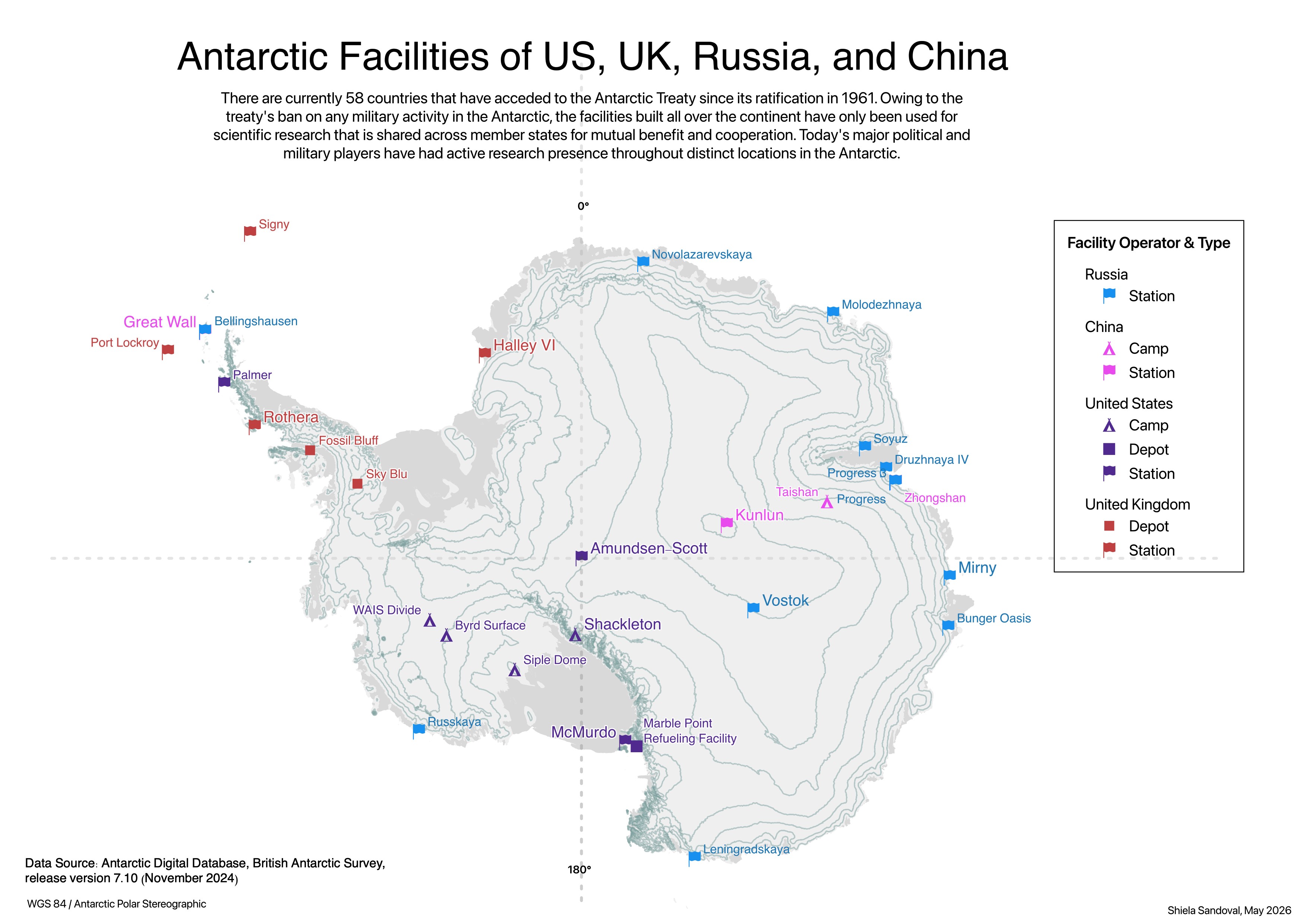
Today’s major political powers have had long established facilities in the Antarctic since World War II. The British, for instance, conducted a top secret expedition called Operation Tabarin (later renamed to Falkland Islands Dependencies Survey and finally to the British Antarctic Survey in 1962) to establish its territorial sovereignty in the region[3]. Port Lockroy (also called “Station A”) was one of the first few bases built under the operation. This and many others built in the 1950s to the 80s have since become permanently occupied research stations, while some abandoned ones were either demolished or turned into historic sites.
The years leading up to the ratification of the Antarctic Treaty saw a race between the United States and the Soviet Union in setting up its own presence in this remote continent. In 1955, the United States built McMurdo station under a military operation called Operation Deep Freeze[4]. Meanwhile, the Soviet Union also started launching expeditions closer towards the eastern longitudes. The 1st Soviet Antarctic Expedition established Mirny station right around 90°E in February 1956[5]. Later that same year and still under Operation Deep Freeze, a team led by the US navy was first to winterover at the geographic South Pole, establishing the Amundsen-Scott South Pole Station, named after Roald Amundsen, the first to reach the South Pole in 1911. As expected, in the following year, the 2nd Soviet Antarctic Expedition brought the Soviet Union farther south and inland than their first expedition, and founded Vostok station, one of the driest and coldest places on Earth.
China entered the treaty much later in 1983. Its first station, Great Wall (Chang Cheng), was built a year after in the Fildes Peninsula close to the southern tip of South America. It also operates the second closest station to the South Pole, named Kunlun, built in 2009[6].
References
[1] List of Parties [signatories to the Antarctic Treaty]. Secretariat of the Antarctic Treaty. https://www.ats.aq/devAS/Parties?lang=e
[2] The Antarctic Treaty (Original facsimile). https://www.ats.aq/e/antarctictreaty.html
[3] History of British stations and refuges. British Antarctic Survey. https://www.bas.ac.uk/about/history/british-research-stations-and-refuges/
[4] Antarctic Infrastructure and Logistics (AIL). US National Science Foundation. https://www.nsf.gov/od/opp/ail
[5] “How many Antarctic stations does Russia have?”. 26 Feb 2023. Gateway to Russia. https://www.gw2ru.com/lifestyle/2670-russian-antarctic-stations
[6] “China’s Antarctic Stations Grow Unabated”. Rear Admiral Monty Khanna. 11 April 2025. National Maritime Foundation. https://maritimeindia.org/chinas-antarctic-stations-grow-unabated/
Map Data sources
- Gerrish, L., Ireland, L., Fretwell, P., & Cooper, P. (2024). High resolution vector polygons of the Antarctic coastline - VERSION 7.10 (Version 7.10) [Data set]. NERC EDS UK Polar Data Centre. https://doi.org/10.5285/4ecd795d-e038-412f-b430-251b33fc880e
Further Reading
Becoming an Antarctic Treaty Consultative Party (Annex to the Antarctic Treaty). https://www.ats.aq/e/becoming.html
The militarization of Russian polar politics. (6 June 2022). Mathieu Boulègue. Consulting Fellow, Russia and Eurasia Programme. https://www.chathamhouse.org/2022/06/militarization-russian-polar-politics/05-antarctica-southern-ocean-and-south-pole
Research Stations. British Antarctic Survey. https://www.bas.ac.uk/polar-capabilities/research-stations/
Tools used
- QGIS 4